Searching for Kung Fu
Introduction
Searching for Kung Fu is a documentary film directed by Laurence J. Brahm, an American filmmaker and martial arts practitioner known for his deep connection with Chinese culture and martial arts. The film explores the historical and philosophical roots of kung fu, a discipline that has captivated audiences worldwide for its breathtaking stunts and rich cultural heritage. Unlike the common perception of kung fu as merely a combat sport, Brahm highlights its deeper significance as an art of nonviolence and personal development. Through this documentary, Brahm embarks on a journey to uncover the origins and values embedded in this ancient Chinese tradition.
Background
Kung fu is often translated into English as "martial arts," a term that suggests a focus on military combat. However, Laurence Brahm offers a contrasting perspective by dissecting the Chinese characters for wu, which comprise ge (dagger-axe) and zhi (to stop). This interpretation implies that kung fu embodies the art of stopping conflict, rather than perpetuating it. Brahm's documentary, Searching for Kung Fu, invites audiences on a pilgrimage to historically significant locations to delve into the origins and principles of kung fu. This cultural exploration seeks to uncover the profound values and philosophies that have sustained kung fu's appeal through millennia.
Brahm's personal journey with kung fu began in the 1970s in Hawaii, where he was trained in karate. His master advised him to visit the Shaolin Temple in China, an important cradle of Chinese martial arts, to gain a comprehensive understanding of the influences on karate's development. This advice set Brahm on a path of exploration and discovery, ultimately leading to his deep-seated passion for documenting the essence of kung fu. Over the decades, Brahm's commitment to martial arts has remained unwavering, underpinning his work as a lawyer, government adviser, and filmmaker.
Plot
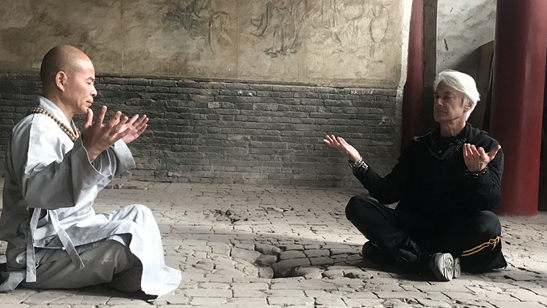
Searching for Kung Fu follows Laurence Brahm as he embarks on a quest to trace the origins and explore the diverse styles of kung fu. The film documents his travels to various locations of historical importance, including the Shaolin Temple, the Chenjiagou village, and Jingwu Town. These locations are pivotal in the development of martial arts and serve as the backdrop for Brahm's investigation into the cultural and philosophical roots of kung fu.
In the film, Brahm engages with numerous kung fu masters and scholars, absorbing their insights and weaving them into a narrative that underscores the discipline's core values. These include perseverance, roots, loyalty, respect, harmony, change, balance, centering, emptiness, flow, pragmatism, and nonviolence. Through interviews and personal reflections, Brahm illustrates how kung fu transcends physical prowess to become a lifestyle rooted in wisdom and moral strength.
Production
Development
The conception of Searching for Kung Fu was a gradual process, nurtured by Brahm's lifelong engagement with martial arts. His vision for the film materialized in 2018 when he found a producer willing to bring this project to fruition. Brahm's dedication to understanding and documenting kung fu's essence is evident in his meticulous research and planning, which laid the foundation for the documentary's narrative.
Filming
Filming commenced in May 2019, with Brahm and his team traveling across China to capture the essence of kung fu in its historical and cultural context. The documentary's filming locations were chosen for their historical significance and connection to kung fu's evolution. These included the Shaolin Temple, known as the cradle of various kung fu styles; Chenjiagou village, recognized for its contribution to Chen-style tai chi; and Jingwu Town, celebrated as the birthplace of kung fu luminary Huo Yuanjia. Brahm's interactions with respected figures, such as Shi Deyang, added depth and authenticity to the documentary, enabling viewers to gain insight into the heritage and traditions of kung fu.
Reception
Searching for Kung Fu has been well-received for its thoughtful exploration of martial arts' philosophical underpinnings. The documentary has resonated with audiences globally, not only for its stunning visuals and historical insights but also for its emphasis on the universal values that kung fu embodies. Brahm's narrative challenges preconceived notions about martial arts, encouraging viewers to appreciate kung fu's role as a vehicle for personal growth and cultural exchange.
Cultural Impact
The cultural impact of Searching for Kung Fu extends beyond the film itself, as it serves as a catalyst for dialogue and understanding across different cultures. By showcasing kung fu's foundational principles, Brahm contributes to a broader appreciation of Chinese culture and its enduring values. The documentary highlights kung fu's potential as a form of cultural diplomacy, promoting mutual respect and understanding among diverse communities. Brahm's work underscores the role of martial arts as a bridge between East and West, advocating for a shared commitment to peace and nonviolence.








